IMPORTANT NOTICE: PRELIMINARY INFORMATION
This page provides an early announcement of ISOEN 2028. All information presented here is preliminary and subject to change as conference planning progresses. In particular, the scientific program, invited speakers, submission deadlines, registration procedures, and participation fees have not yet been finalized.
The official ISOEN 2028 conference website will be published by the International Society on Olfaction and Chemical Sensing (ISOCS). Once available, it will serve as the authoritative source for all confirmed information, including the call for papers, registration, accommodation arrangements, and practical details for participants.ISOEN 2028 | Dresden, Germany
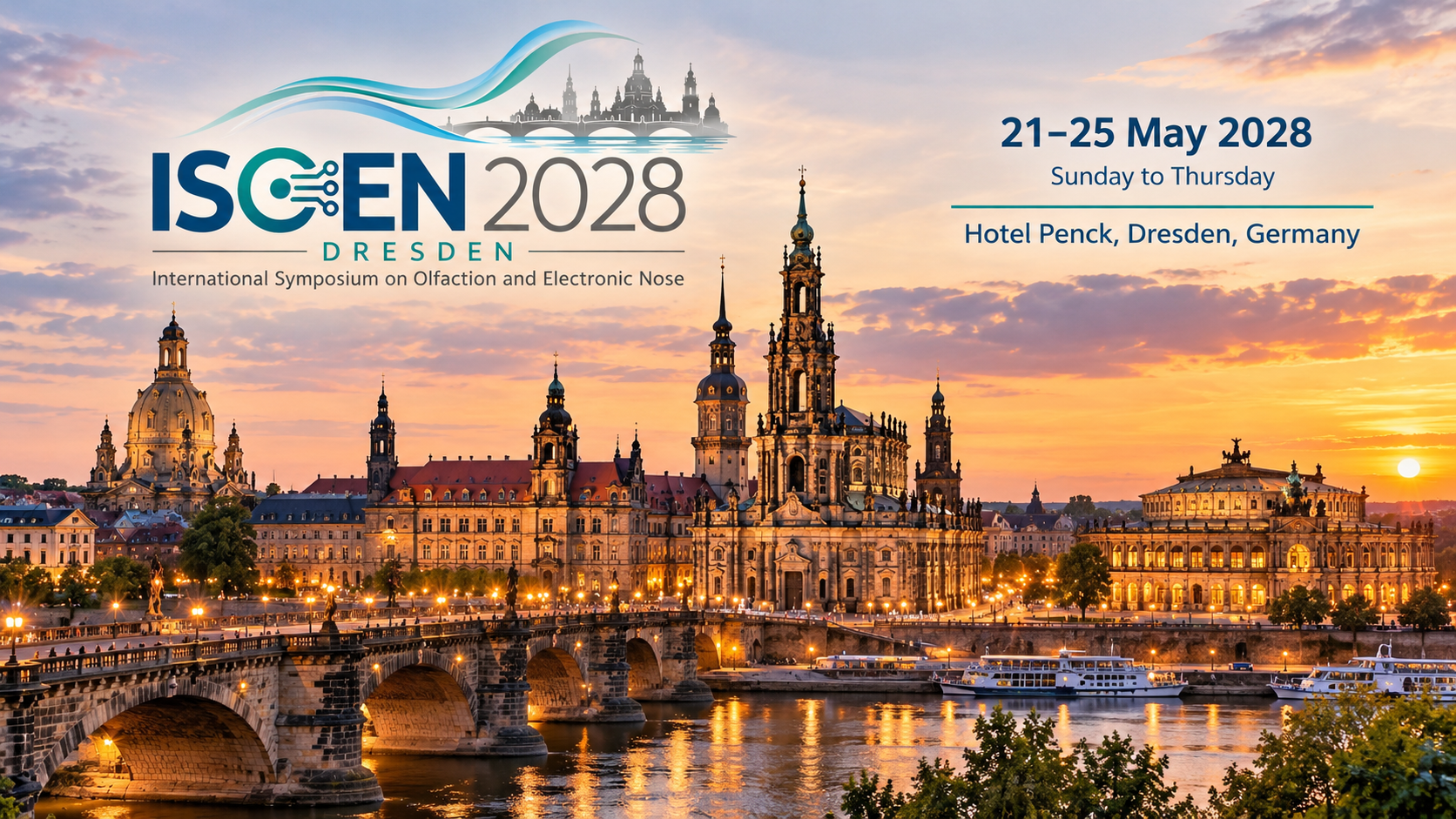
International Symposium on Olfaction and Electronic Nose21-24 May 2028 | Sunday to WednesdayVenue: Hotel Penck, Dresden, GermanyLocal Organization: Technische Universität Dresden (TU Dresden), Chair of Materials Science and NanotechnologySave the Date: ISOEN 2028 Comes to Dresden!
We are delighted to announce that the International Symposium on Olfaction and Electronic Nose (ISOEN 2028) is planned to take place in Dresden, Germany, from Sunday, 21 May, to Wednesday, 24 May 2028.
Following previous successful editions in Montreal (2017), Fukuoka (2019), Aveiro (2022), Dallas (2024), and Chongqing (2026), ISOEN 2028 will bring the international scientific community together in one of Europe's most distinctive research and cultural cities.
ISOEN is a leading international scientific forum dedicated to the development of artificial olfaction, electronic noses, electronic tongues, chemical sensing technologies, and their applications. The symposium provides a meeting point for researchers, engineers, clinicians, industrial innovators, and young scientists working across materials science, physics, chemistry, biology, electronics, artificial intelligence, and engineering.
The conference aims to stimulate scientific exchange, promote interdisciplinary collaboration, and accelerate the translation of fundamental discoveries into reliable sensing technologies with tangible societal and industrial impact.
Dresden offers a particularly stimulating environment for this dialogue. Its strong research institutions, internationally connected scientific community, and thriving semiconductor and high-technology ecosystem provide an excellent setting for discussing the next generation of intelligent chemical sensing technologies.
Scientific Scope: From Molecules and Materials to Intelligent Perception
The scientific scope of ISOEN spans the complete chain from chemical interactions at the molecular level to sensing devices, integrated systems, intelligent data analysis, and real-world applications.
The 2028 symposium aims to explore emerging scientific and technological opportunities across several interconnected research areas.
Advanced Materials and Next-Generation Chemical SensorsNovel sensing principles, nanomaterials, low-dimensional materials, functional interfaces, metal oxides, organic semiconductors, and hybrid sensing architectures. Particular attention will be given to improving sensitivity, selectivity, response time, energy efficiency, and long-term operational stability.
Electronic Noses, Electronic Tongues, and Multisensor SystemsDevelopment of integrated sensing platforms capable of recognizing complex chemical signatures. Topics include sensor arrays, multiparametric sensing, miniaturized analytical systems, multisensor data fusion, and the design of compact, robust, and scalable instruments.
Bioinspired Olfaction and Biological SensingBiological olfactory receptors, biomimetic sensor architectures, biohybrid systems, olfactory neuroscience, and the fundamental mechanisms underlying chemical perception. The interaction between biological and artificial sensing systems represents an important opportunity for future innovation.
Artificial Intelligence and Machine Learning for Chemical SensingAdvanced signal processing, chemometrics, machine learning, deep learning, transfer learning, and physics-informed approaches for extracting reliable information from complex sensor responses. Particular challenges include sensor drift, calibration transfer, environmental variability, interpretability, and generalization beyond controlled laboratory conditions.
Medical Diagnostics and Human HealthBreath analysis, volatile biomarkers, non-invasive diagnostics, disease monitoring, personalized medicine, and wearable chemical sensing. Interdisciplinary collaboration between sensor developers, analytical scientists, and clinicians is essential for translating promising research results into clinically validated technologies.
Environmental Monitoring, Sustainability, and Industrial ApplicationsMonitoring of atmospheric pollutants, industrial emissions, hazardous substances, environmental odors, food quality, agricultural processes, and manufacturing environments. Reliable chemical sensing offers opportunities for improved safety, environmental protection, process efficiency, and resource management.
Robotic Olfaction, Multisensory Perception, and Physical AIThe integration of chemical sensing into autonomous and intelligent physical systems is opening a new frontier in artificial perception. Robots capable of detecting, identifying, and localizing chemical substances could support environmental exploration, industrial inspection, emergency response, and human-robot interaction.
Beyond machine vision, the emerging paradigm of Physical AI will increasingly require diverse sensory capabilities, including the ability to perceive chemical information in complex and dynamic environments.
Reliability, Calibration, Benchmarking, and StandardizationAs electronic noses move from research laboratories toward broader deployment, reproducibility, instrument comparability, traceability, and robust validation become critical. Standardized testing protocols and scientifically sound performance metrics are essential for transforming promising sensor technologies into dependable measurement instruments.
Connecting Fundamental Research, Technology, and Applications
One of the defining characteristics of ISOEN is its interdisciplinary nature. Advances in artificial olfaction require progress not only in sensing materials and electronic devices, but also in molecular recognition, sampling strategies, system integration, data science, and application-specific validation.
A central challenge remains the translation of laboratory demonstrations into sensing systems capable of operating reliably under realistic conditions.
ISOEN 2028 aims to provide a forum for addressing these challenges through discussions that connect fundamental scientific understanding with engineering implementation and practical applications.
The symposium will also encourage interactions between academic researchers and companies developing sensing components, instruments, analytical platforms, and complete solutions.
The participation of young researchers, doctoral students, and early-career scientists will be particularly important for fostering new scientific networks and encouraging the next generation of innovation in artificial olfaction.
Preliminary Conference Format
Based on the traditions of previous ISOEN meetings, the symposium is expected to feature a combination of scientific and networking activities.
These may include keynote and invited lectures from internationally recognized experts, contributed oral presentations, thematic scientific sessions, poster sessions, tutorials, and opportunities for demonstrating emerging technologies.
Dedicated activities encouraging interaction between academia and industry, as well as informal discussions and networking events, are also envisaged.
The detailed program, including possible tutorials, special sessions, competitions, and social activities, remains under development and will be announced through the official conference website.
Welcome to Dresden!
Located on the banks of the River Elbe, Dresden, the capital of Saxony, is celebrated as one of Germany's most beautiful cultural and scientific cities.
Often referred to as the
Florence on the Elbe, Dresden offers an exceptional combination of magnificent Baroque architecture, world-renowned museums, outstanding musical traditions, and a vibrant contemporary cultural scene.
The historic city center features some of Europe's most recognizable architectural landmarks. The monumental Frauenkirche, meticulously reconstructed after its destruction during the Second World War, stands as an international symbol of reconciliation and renewal.
The Semperoper, home to the Saxon State Opera, represents Dresden's extraordinary musical heritage. The magnificent Zwinger Palace and the Dresden Royal Palace host internationally renowned art collections, including the celebrated Green Vault.
The monumental Catholic Court Church, also known as the Hofkirche, the historic Augustus Bridge, and the picturesque Elbe riverfront together form one of the most impressive urban panoramas in Europe.
Dresden is also a city of music, with a cultural tradition associated with composers such as Richard Wagner, Carl Maria von Weber, and Richard Strauss, and institutions including the Staatskapelle Dresden, one of the world's oldest orchestras.
Beyond its architectural treasures, Dresden offers numerous opportunities to discover the surrounding region.
The Elbe Valley is known for its picturesque vineyards, historic castles, and charming towns. The nearby Saxon Switzerland region features dramatic sandstone cliffs, extraordinary rock formations, and extensive hiking trails, making it an exceptional destination for nature lovers.
The historic city of Meissen, famous for its porcelain manufacture, and the elegant Pillnitz Palace are also within easy reach.
For conference participants, Dresden provides an opportunity to combine scientific exchange with an enriching cultural experience.
Discover Dresden and its surroundings:Dresden Tourism |
Frauenkirche |
Semperoper |
Dresden Museums and Zwinger |
Green Vault |
Elbe River Cruises |
Saxon SwitzerlandDresden: A European Hub for Science and Technology
Beyond its cultural heritage, Dresden is recognized as one of Germany's leading centers for research, innovation, and high-technology manufacturing.
The city hosts a dense network of universities, research organizations, technology companies, and industrial partners.
Its research landscape includes TU Dresden, several Max Planck Institutes, Fraunhofer Institutes, and Leibniz research institutions, creating a highly interconnected environment for interdisciplinary scientific collaboration.
Dresden is also at the heart of Silicon Saxony, one of Europe's most important semiconductor and microelectronics ecosystems.
This concentration of expertise in microelectronics, nanotechnology, advanced materials, electronics, and systems engineering makes Dresden a particularly relevant location for a conference dedicated to chemical sensors and intelligent sensing technologies.
The proximity between fundamental materials research, device development, industrial manufacturing, and emerging artificial intelligence technologies provides excellent opportunities for developing new collaborations and strengthening the international sensor community.
TU Dresden: Celebrating 200 Years of Scientific and Technological Progress
The local organization of ISOEN 2028 is provided by
Technische Universität Dresden (TU Dresden), through its
Chair of Materials Science and Nanotechnology, headed by
Professor Gianaurelio Cuniberti.
The symposium will take place during a particularly significant year for Dresden's scientific community.
In 2028, TU Dresden celebrates its 200th anniversary.Founded in 1828, TU Dresden has developed from a technical educational institution into a comprehensive research university with an international reputation in engineering, natural sciences, medicine, and interdisciplinary research.
Over two centuries, the university has contributed to scientific discovery, technological progress, industrial development, and the education of generations of engineers and scientists.
Today, TU Dresden is one of Germany's Universities of Excellence, with internationally recognized research activities spanning advanced materials, microelectronics, artificial intelligence, biotechnology, energy systems, and many other fields.
The bicentennial celebrations offer an exceptional historical context for ISOEN 2028, bringing together the traditions of scientific discovery and engineering innovation with the emerging technological challenges of the coming decades.
More information:
Technische Universität DresdenMore Than 20 Years of Materials Science and Nanotechnology at TU Dresden
ISOEN 2028 will also provide an opportunity to celebrate another important milestone:
more than 20 years of the Chair of Materials Science and Nanotechnology under the leadership of Professor Gianaurelio Cuniberti.
Since 2007, the Chair has developed an interdisciplinary research program at the interface of physics, chemistry, materials science, nanotechnology, molecular electronics, and computational science.
Its activities connect fundamental investigations of matter at the nanoscale with the development of functional materials, electronic devices, and sensing technologies.
A particularly relevant research direction is the exploration of novel low-dimensional materials, nanostructured interfaces, and intelligent electronic devices for chemical sensing and artificial olfaction.
By combining materials engineering, fundamental understanding of sensing mechanisms, device integration, and data-driven approaches, the Chair contributes to the development of emerging technologies for advanced sensors and electronic noses.
Research activities also extend toward broader questions of intelligent materials, nanoelectronics, and the integration of physical sensing with artificial intelligence.
The Chair's international collaborations and interdisciplinary research environment reflect the spirit of ISOEN, where progress depends on bringing together different scientific disciplines and technological perspectives.
More information:
Chair of Materials Science and NanotechnologyA Double Celebration: 200 Years of TU Dresden and More Than 20 Years of Nanotechnology
ISOEN 2028 will therefore take place in the context of a double scientific celebration.
200 years of TU Dresden, founded in 1828.More than 20 years of the Chair of Materials Science and Nanotechnology, led by Professor Cuniberti since 2007.These two anniversaries connect the historical foundations of scientific and technological progress with the contemporary frontiers of nanotechnology, intelligent sensors, and artificial perception.
They also offer an opportunity to reflect on the evolution of scientific instrumentation: from the measurement technologies of the industrial age to modern nanoscale devices, sensor networks, and AI-enabled systems capable of interpreting increasingly complex physical and chemical environments.
Against this backdrop, ISOEN 2028 will provide an international forum for discussing how new materials, sensing architectures, and computational approaches can contribute to the next generation of intelligent technologies.
Conference Venue: Hotel Penck Dresden
The symposium is planned to take place at
Hotel Penck in Dresden, Germany.
Located close to Dresden's historic city center, the hotel provides a convenient setting for bringing together the international ISOEN community.
Its location offers participants easy access to many of Dresden's principal cultural attractions, including the historic Old Town, the Elbe riverfront, and the city's renowned architectural landmarks.
The venue is intended to support both the formal scientific program and the informal interactions that are essential for establishing new research collaborations.
Details regarding conference facilities, accommodation options, special conference rates, and transportation will be provided through the official conference website as arrangements are finalized.
We Look Forward to Welcoming You to Dresden!
ISOEN 2028 aims to bring together the international artificial olfaction and chemical sensing community for stimulating scientific discussions, interdisciplinary exchange, and the development of new collaborations.
We look forward to welcoming established researchers, young scientists, industrial partners, and newcomers to the field to Dresden.
In a year celebrating two centuries of TU Dresden and more than two decades of Materials Science and Nanotechnology, we hope to make ISOEN 2028 a memorable gathering that connects scientific tradition with the future of intelligent sensing.
Save the Date: 21-24 May 2028 | Sunday to WednesdayISOEN 2028 | Dresden, GermanyFurther information regarding the scientific program, important deadlines, abstract submissions, registration, and accommodation will be announced on the official ISOCS conference website. All preliminary information remains subject to change.