We show that a spinor traveling along a one-dimensional helical path develops a spin–orbit coupling as a result of the curvature of the path. We estimate the magnitude of the associated spin polarization and obtain values typical of many helical molecular structures that showcase the Chirality-induced Spin Selectivity (CISS) effect. We find that this chirality-induced spin–orbit coupling (χ-SOC), in conjunction with broken time-reversal symmetry, may be an important ingredient for the microscopic underpinning of the CISS phenomenon.
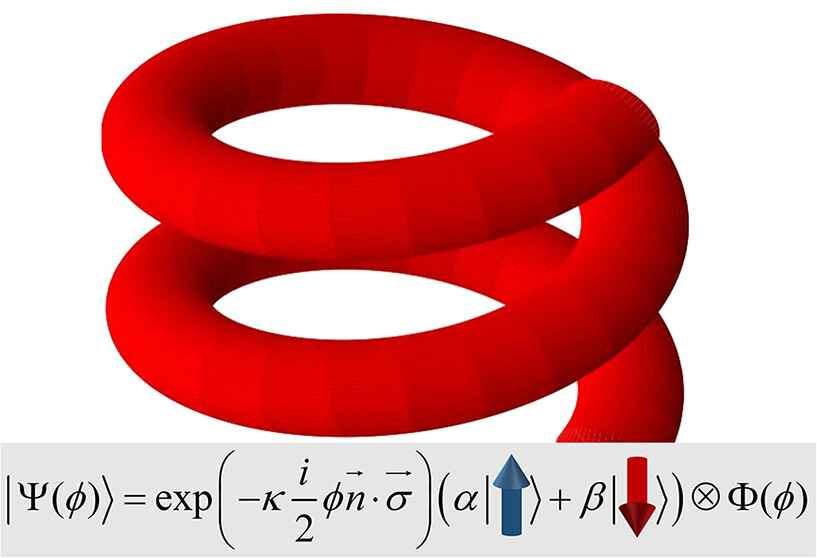

We show that a spinor traveling along a one-dimensional helical path develops a spin–orbit coupling as a result of the curvature of the path. We estimate the magnitude of the associated spin polarization and obtain values typical of many helical molecular structures that showcase the Chirality-induced Spin Selectivity (CISS) effect. We find that this chirality-induced spin–orbit coupling (χ-SOC), in conjunction with broken time-reversal symmetry, may be an important ingredient for the microscopic underpinning of the CISS phenomenon.