 PMMA/pPFPA membrane with low content of modified TiO2 nanoparticles for effective retention of pharmaceuticals from water
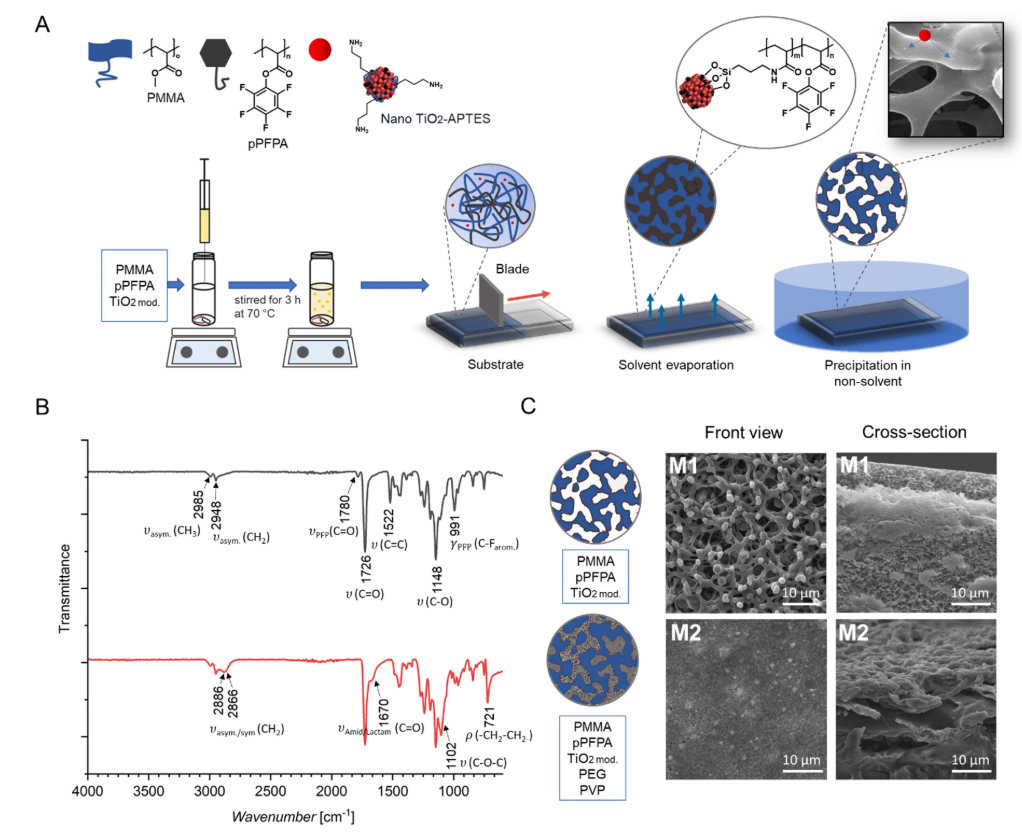
In this work, we addressed the issue of pharmaceutical pollution in water by developing new polymer-based membranes with superior separation and photocatalytic properties. The membranes were prepared via the phase-inversion method using poly(methyl methacrylate) (PMMA) and poly(pentafluorophenyl acrylate) (pPFPA) as the main polymers. To enhance absorption capacity and activate photocatalytic properties, modified TiO₂ nanoparticles (TiO2, mod.) were introduced in low concentration. Two porous membranes were fabricated: M1, consisting of PMMA, pPFPA, and TiO2, mod. nanoparticles; and M2, containing the same components as M1 but additionally supplemented with high molecular weight poly(ethylene glycol) (PEG) and polyvinylpyrrolidone (PVP). The incorporation of high-molecular-weight PEG and PVP reduced void formation in the membrane structure, resulting in a denser morphology with smaller pores. The membrane morphology and surface properties were characterised using scanning electron microscopy (SEM), Fourier transform infrared spectroscopy (FTIR), zeta potential measurements, and captive bubble contact angle analysis. The average pore diameter decreased from 0.025 μm to 0.0037 μm (85% reduction), resulting in a more uniform pore-size distribution and enhanced membrane structural stability. The surface hydrophilicity, measured using the captive bubble method, improved from 20° to 15°, corresponding to a 25% decrease in contact angle, indicating enhanced hydrophilicity of the PMMA/pPFPA/TiO2, mod./PEG/PVP membrane. The membrane was tested against a pharmaceutical mixture of metoprolol (MPL), ibuprofen (IBU), and diclofenac (DCF) in dynamic (cross-flow) and static (photocatalysis, sorption) modes. The cross-flow membrane rejection of pharmaceuticals followed the order DCF < IBU < MPL and did not exceed 30%. Independent sorption experiments indicated retention rates of 50–70%, while photocatalytic degradation achieved complete removal (100%) within 2 h. These results clearly separate the contributions of rejection, sorption, and photocatalysis, highlighting the membrane’s potential for practical applications in water treatment.
 PMMA/pPFPA membrane with low content of modified TiO2 nanoparticles for effective retention of pharmaceuticals from water
In this work, we addressed the issue of pharmaceutical pollution in water by developing new polymer-based membranes with superior separation and photocatalytic properties. The membranes were prepared via the phase-inversion method using poly(methyl methacrylate) (PMMA) and poly(pentafluorophenyl acrylate) (pPFPA) as the main polymers. To enhance absorption capacity and activate photocatalytic properties, modified TiO₂ nanoparticles (TiO2, mod.) were introduced in low concentration. Two porous membranes were fabricated: M1, consisting of PMMA, pPFPA, and TiO2, mod. nanoparticles; and M2, containing the same components as M1 but additionally supplemented with high molecular weight poly(ethylene glycol) (PEG) and polyvinylpyrrolidone (PVP). The incorporation of high-molecular-weight PEG and PVP reduced void formation in the membrane structure, resulting in a denser morphology with smaller pores. The membrane morphology and surface properties were characterised using scanning electron microscopy (SEM), Fourier transform infrared spectroscopy (FTIR), zeta potential measurements, and captive bubble contact angle analysis. The average pore diameter decreased from 0.025 μm to 0.0037 μm (85% reduction), resulting in a more uniform pore-size distribution and enhanced membrane structural stability. The surface hydrophilicity, measured using the captive bubble method, improved from 20° to 15°, corresponding to a 25% decrease in contact angle, indicating enhanced hydrophilicity of the PMMA/pPFPA/TiO2, mod./PEG/PVP membrane. The membrane was tested against a pharmaceutical mixture of metoprolol (MPL), ibuprofen (IBU), and diclofenac (DCF) in dynamic (cross-flow) and static (photocatalysis, sorption) modes. The cross-flow membrane rejection of pharmaceuticals followed the order DCF < IBU < MPL and did not exceed 30%. Independent sorption experiments indicated retention rates of 50–70%, while photocatalytic degradation achieved complete removal (100%) within 2 h. These results clearly separate the contributions of rejection, sorption, and photocatalysis, highlighting the membrane’s potential for practical applications in water treatment.