

Glass is notoriously difficult to “design” because structural information is concealed within disorder. In this lecture, a connection is drawn between two worlds that are rarely aligned: a glass that can be resolved atom by atom and a glass that can be designed digitally. The starting point is provided by ultrathin silica bilayers on Ru (0001), where the ring network can be read directly at atomic resolution and where the transformation from a crystalline 2D sheet to a vitreous structure can be followed in real space. The atomistic events that enable disorder are then examined, and the roles of bond rearrangements and interactions with the metal support in shaping the pathway and energetics of the crystalline-to-glass transition are discussed. A scale-up from “2D glass” to “digital glass” is subsequently presented. An ontology-based infrastructure is introduced in which composition process–property data are standardized and linked across experiments, simulations, and databases so that knowledge is rendered machine-actionable rather than being trapped in disconnected files. Finally, a closed-loop workflow is outlined in which atomistic modeling, machine-learning predictors, and automated synthesis are coupled and iteratively calibrated, so that validated glass formulations can be reached with substantially reduced trial-and-error.
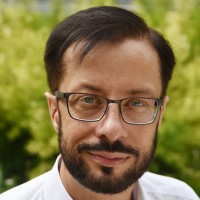
Prof. Dr. Marek Sierka: (born in Kraków, Poland) is a theoretical chemist and Professor of Computational Materials Science at the Otto Schott Institute of Materials Research (OSIM), Friedrich Schiller University Jena, where he leads the Computational Materials Science Group. His work sits at the intersection of modeling and atomistic simulation, with a focus on understanding and predicting the structure, properties, and reactivity of low-dimensional materials such as clusters, nanoparticles, thin layers, and surfaces, as well as developing methods for global structural optimization and the computational design of functional materials. He studied chemistry and physics at the Jagiellonian University (Poland), the University of Bergen (Norway), and the Humboldt University of Berlin, earning an M.Sc. in Chemistry in 1996. He received his doctorate in chemistry from Humboldt University of Berlin in 2000 under the supervision of Joachim Sauer (summa cum laude) and completed his habilitation in theoretical chemistry there in 2009. Alongside his academic career, he is one of the founders of TURBOMOLE GmbH (est. 2007), supporting the continued development and dissemination of the TURBOMOLE quantum-chemistry software suite.

Glass is notoriously difficult to “design” because structural information is concealed within disorder. In this lecture, a connection is drawn between two worlds that are rarely aligned: a glass that can be resolved atom by atom and a glass that can be designed digitally. The starting point is provided by ultrathin silica bilayers on Ru (0001), where the ring network can be read directly at atomic resolution and where the transformation from a crystalline 2D sheet to a vitreous structure can be followed in real space. The atomistic events that enable disorder are then examined, and the roles of bond rearrangements and interactions with the metal support in shaping the pathway and energetics of the crystalline-to-glass transition are discussed. A scale-up from “2D glass” to “digital glass” is subsequently presented. An ontology-based infrastructure is introduced in which composition process–property data are standardized and linked across experiments, simulations, and databases so that knowledge is rendered machine-actionable rather than being trapped in disconnected files. Finally, a closed-loop workflow is outlined in which atomistic modeling, machine-learning predictors, and automated synthesis are coupled and iteratively calibrated, so that validated glass formulations can be reached with substantially reduced trial-and-error.
Prof. Dr. Marek Sierka: (born in Kraków, Poland) is a theoretical chemist and Professor of Computational Materials Science at the Otto Schott Institute of Materials Research (OSIM), Friedrich Schiller University Jena, where he leads the Computational Materials Science Group. His work sits at the intersection of modeling and atomistic simulation, with a focus on understanding and predicting the structure, properties, and reactivity of low-dimensional materials such as clusters, nanoparticles, thin layers, and surfaces, as well as developing methods for global structural optimization and the computational design of functional materials. He studied chemistry and physics at the Jagiellonian University (Poland), the University of Bergen (Norway), and the Humboldt University of Berlin, earning an M.Sc. in Chemistry in 1996. He received his doctorate in chemistry from Humboldt University of Berlin in 2000 under the supervision of Joachim Sauer (summa cum laude) and completed his habilitation in theoretical chemistry there in 2009. Alongside his academic career, he is one of the founders of TURBOMOLE GmbH (est. 2007), supporting the continued development and dissemination of the TURBOMOLE quantum-chemistry software suite.
