 Integrated Flexible Zwitterionic Electrochemical Sensor Platform for Real-Time Salivary Glucose Quantification
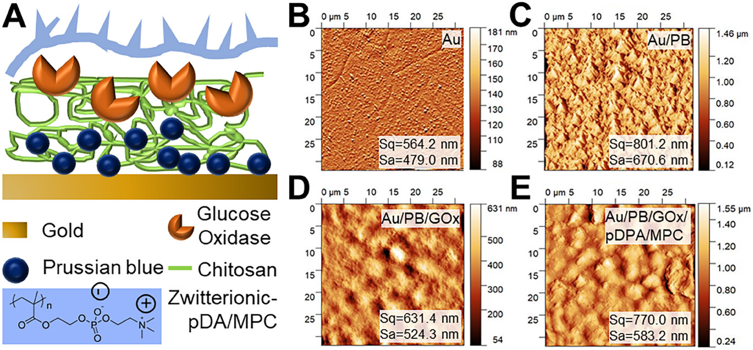
Achieving and maintaining optimal oral health necessitates a comprehensive understanding of the complex bio‐adhesive and metabolic processes occurring within the oral cavity. These processes are significantly influenced by the intricate composition of oral fluids, particularly saliva and its resident microbiome. Currently available methodologies struggle to accurately monitor the dynamic and heterogeneous nature of key oral biomarkers, such as glucose. The development of miniaturized sensors for continuous and quantitative monitoring of clinically relevant salivary parameters represents a significant advancement in diagnostic capabilities. This work introduces an electrochemical sensor array designed for the continuous, quantitative monitoring of the clinically relevant and paradigmatic metabolite glucose. To address the challenges posed by the complex salivary environment, a surface modification strategy is implemented involving hybrid films of Prussian blue with chitosan and glucose oxidase enzyme entrapped within chitosan. The incorporation of chitosan, along with the further integration of zwitterionic polymer based on self‐polymerized dopamine (pDA) and 2‐ Methacryloyloxyethyl Phosphoryl Choline (MPC), facilitates the sensitive, selective, and reliable glucose monitoring in harsh salivary environments. Continuous amperometric glucose monitoring showcases the platform's capability for real‐time quantification, as increasing glucose concentrations correspond with elevated current signals. Pilot experiments show the sensors' capacity to precisely quantify salivary glucose levels and ascertain unknown concentrations, validated through the use of commercial glucometers. While the initial focus lies on glucose detection as a proof of concept, the final device integrates multiple electrochemical and potentiometric sensors. This advanced configuration enables the comprehensive quantification of several clinically relevant parameters in saliva. The development of multi‐sensor devices for continuous monitoring within the oral cavity holds immense potential: by unlocking deeper insights into the mechanisms driving the onset and progression of oral diseases, it will pave the way for further innovations in preventive dentistry.
 Integrated Flexible Zwitterionic Electrochemical Sensor Platform for Real-Time Salivary Glucose Quantification
Achieving and maintaining optimal oral health necessitates a comprehensive understanding of the complex bio‐adhesive and metabolic processes occurring within the oral cavity. These processes are significantly influenced by the intricate composition of oral fluids, particularly saliva and its resident microbiome. Currently available methodologies struggle to accurately monitor the dynamic and heterogeneous nature of key oral biomarkers, such as glucose. The development of miniaturized sensors for continuous and quantitative monitoring of clinically relevant salivary parameters represents a significant advancement in diagnostic capabilities. This work introduces an electrochemical sensor array designed for the continuous, quantitative monitoring of the clinically relevant and paradigmatic metabolite glucose. To address the challenges posed by the complex salivary environment, a surface modification strategy is implemented involving hybrid films of Prussian blue with chitosan and glucose oxidase enzyme entrapped within chitosan. The incorporation of chitosan, along with the further integration of zwitterionic polymer based on self‐polymerized dopamine (pDA) and 2‐ Methacryloyloxyethyl Phosphoryl Choline (MPC), facilitates the sensitive, selective, and reliable glucose monitoring in harsh salivary environments. Continuous amperometric glucose monitoring showcases the platform's capability for real‐time quantification, as increasing glucose concentrations correspond with elevated current signals. Pilot experiments show the sensors' capacity to precisely quantify salivary glucose levels and ascertain unknown concentrations, validated through the use of commercial glucometers. While the initial focus lies on glucose detection as a proof of concept, the final device integrates multiple electrochemical and potentiometric sensors. This advanced configuration enables the comprehensive quantification of several clinically relevant parameters in saliva. The development of multi‐sensor devices for continuous monitoring within the oral cavity holds immense potential: by unlocking deeper insights into the mechanisms driving the onset and progression of oral diseases, it will pave the way for further innovations in preventive dentistry.