 An Optimized Electrochemical Biosensor for Real-Time Monitoring of Lactate in Human Saliva With Enhanced Sensitivity, Stability, and Reproducibility
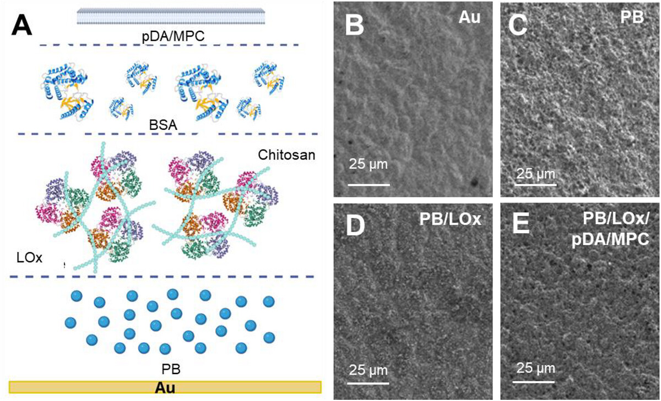
Non‐invasive lactate monitoring in saliva holds considerable potential for disease diagnostics and personalized oral healthcare. However, the complex salivary matrix, characterized by high protein content, pellicle formation, and elevated viscosity, poses major challenges for electrochemical biosensors, including biofouling, signal interference, and limited stability. Here, we present an electrochemical lactate biosensor rationally engineered for reliable operation in untreated human saliva. A multilayer surface architecture comprising Prussian Blue, lactate oxidase, bovine serum albumin (BSA), and a zwitterionic polydopamine–MPC (pDA/MPC) coating minimizes nonspecific adsorption while preserving substrate accessibility. The optimized sensor exhibits a sensitivity of −0.48 µA/ mM
and a linear range up to 2.5 mM in phosphate buffer at an operating potential of +0.055 V. In untreated human saliva, the sensor accurately quantified endogenous lactate and detected up to an additional 1 mM lactate before reaching saturation, covering the physiologically relevant concentration range. The multilayer architecture further provided stable and reproducible responses with negligible interference from glucose, uric acid, and ascorbic acid. Cytotoxicity studies using human gingival fibroblasts confirmed the biocompatibility of the modified sensor surface. These results demonstrate that rational multilayer surface engineering enables robust electrochemical lactate sensing in saliva and represents a promising strategy for future intraoral biosensing applications.
 An Optimized Electrochemical Biosensor for Real-Time Monitoring of Lactate in Human Saliva With Enhanced Sensitivity, Stability, and Reproducibility
Non‐invasive lactate monitoring in saliva holds considerable potential for disease diagnostics and personalized oral healthcare. However, the complex salivary matrix, characterized by high protein content, pellicle formation, and elevated viscosity, poses major challenges for electrochemical biosensors, including biofouling, signal interference, and limited stability. Here, we present an electrochemical lactate biosensor rationally engineered for reliable operation in untreated human saliva. A multilayer surface architecture comprising Prussian Blue, lactate oxidase, bovine serum albumin (BSA), and a zwitterionic polydopamine–MPC (pDA/MPC) coating minimizes nonspecific adsorption while preserving substrate accessibility. The optimized sensor exhibits a sensitivity of −0.48 µA/ mM
and a linear range up to 2.5 mM in phosphate buffer at an operating potential of +0.055 V. In untreated human saliva, the sensor accurately quantified endogenous lactate and detected up to an additional 1 mM lactate before reaching saturation, covering the physiologically relevant concentration range. The multilayer architecture further provided stable and reproducible responses with negligible interference from glucose, uric acid, and ascorbic acid. Cytotoxicity studies using human gingival fibroblasts confirmed the biocompatibility of the modified sensor surface. These results demonstrate that rational multilayer surface engineering enables robust electrochemical lactate sensing in saliva and represents a promising strategy for future intraoral biosensing applications.