 Fully Recyclable Printed Magnetoresistive Sensors Covering Broad Operational Ranges for Sustainable Interactive Electronics
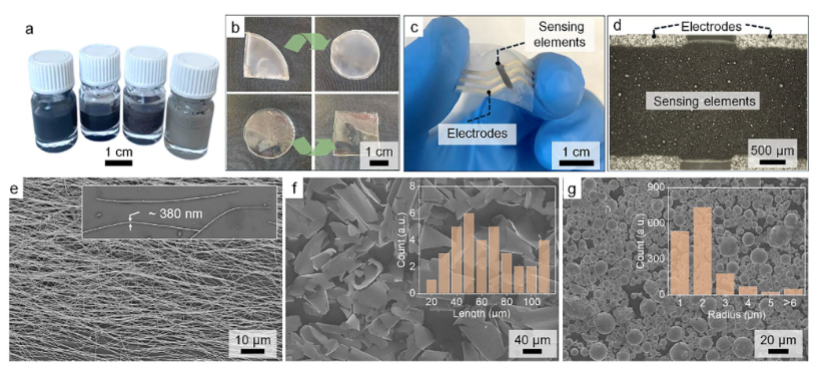
The rapidly growing demand for sensors in the Internet of Things era calls for magnetic sensors that simultaneously deliver high performance, operational versatility, and environmental sustainability. However, simultaneously achieving these goals remains challenging. This work reports a unified material and fabrication strategy that addresses these issues through a green printing and recycling paradigm. By employing a solvent‐orthogonal binder design, i.e., utilizing water‐soluble polyvinyl alcohol for sensing elements and solvent‐soluble poly(methyl methacrylate) for electrodes, we enable high‐fidelity multi‐layer deposition with robust interlayer structural integrity and zero cross‐dissolution, as well as a mild, rapid disassembly process for full material reclaim. The sensors' operational regimes are precisely tailored by varying the dimensionality and magnetic anisotropy of functional fillers. Permalloy microparticle‐based sensors utilize the anisotropic magnetoresistance effect to achieve high sensitivity in low‐field regimes (< 3.5 mT), while Co/Cu nanoflakes and CoNi nanowires leverage giant magnetoresistance and extreme shape anisotropy to extend the sensing range to 65 mT and 420 mT, respectively. Furthermore, our devices exhibit robust environmental stability under water immersion and thermal stress, alongside exceptional endurance over 5,000 magnetization cycles. Finally, the practical utility of this platform is demonstrated through wearable interactive switches and smart‐home motion‐tracking systems.
 Fully Recyclable Printed Magnetoresistive Sensors Covering Broad Operational Ranges for Sustainable Interactive Electronics
The rapidly growing demand for sensors in the Internet of Things era calls for magnetic sensors that simultaneously deliver high performance, operational versatility, and environmental sustainability. However, simultaneously achieving these goals remains challenging. This work reports a unified material and fabrication strategy that addresses these issues through a green printing and recycling paradigm. By employing a solvent‐orthogonal binder design, i.e., utilizing water‐soluble polyvinyl alcohol for sensing elements and solvent‐soluble poly(methyl methacrylate) for electrodes, we enable high‐fidelity multi‐layer deposition with robust interlayer structural integrity and zero cross‐dissolution, as well as a mild, rapid disassembly process for full material reclaim. The sensors' operational regimes are precisely tailored by varying the dimensionality and magnetic anisotropy of functional fillers. Permalloy microparticle‐based sensors utilize the anisotropic magnetoresistance effect to achieve high sensitivity in low‐field regimes (< 3.5 mT), while Co/Cu nanoflakes and CoNi nanowires leverage giant magnetoresistance and extreme shape anisotropy to extend the sensing range to 65 mT and 420 mT, respectively. Furthermore, our devices exhibit robust environmental stability under water immersion and thermal stress, alongside exceptional endurance over 5,000 magnetization cycles. Finally, the practical utility of this platform is demonstrated through wearable interactive switches and smart‐home motion‐tracking systems.