Molecular Field-Coupled Nanocomputing (MolFCN) is a promising beyond-CMOS paradigm in which information is propagated electrostatically rather than through charge transport, enabling ultra-low-power logic. However, identifying molecules with stable logic states and reliable information propagation remains challenging. Here, we introduce LUFFY (Layered Unified Framework for MolFCN systematic analYsis), a framework for the rational design and validation of MolFCN molecular candidates. Starting from 32 synthetically accessible molecules, LUFFY combines conformational sampling and electrostatic analysis in neutral and oxidized states to derive molecular response descriptors. We extract Vin-to-Aggregated-Charge Transcharacteristics (VACTs), capturing the field-induced charge response, and develop energy-averaged models that account for conformational diversity and are validated against ab initio molecular dynamics. We further demonstrate stable information propagation at the device level. LUFFY establishes a unified, transferable, and scalable strategy linking molecular structure to circuit functionality, providing a foundation for data-driven molecular discovery for ultra-low-power computing.
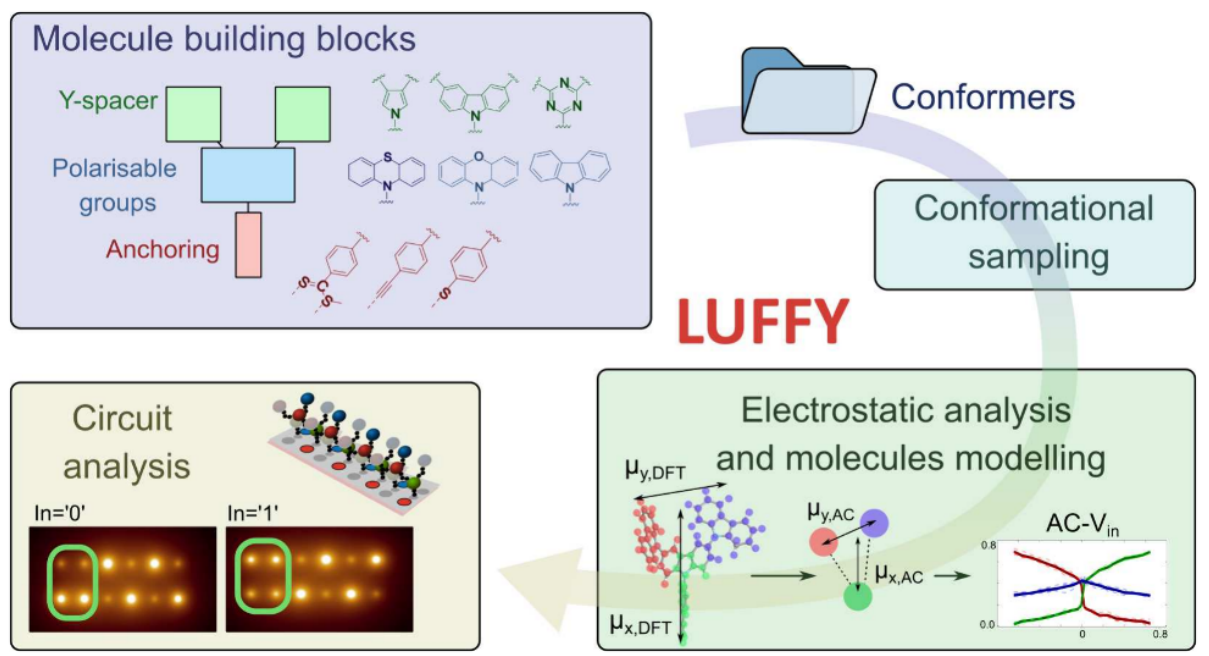

Molecular Field-Coupled Nanocomputing (MolFCN) is a promising beyond-CMOS paradigm in which information is propagated electrostatically rather than through charge transport, enabling ultra-low-power logic. However, identifying molecules with stable logic states and reliable information propagation remains challenging. Here, we introduce LUFFY (Layered Unified Framework for MolFCN systematic analYsis), a framework for the rational design and validation of MolFCN molecular candidates. Starting from 32 synthetically accessible molecules, LUFFY combines conformational sampling and electrostatic analysis in neutral and oxidized states to derive molecular response descriptors. We extract Vin-to-Aggregated-Charge Transcharacteristics (VACTs), capturing the field-induced charge response, and develop energy-averaged models that account for conformational diversity and are validated against ab initio molecular dynamics. We further demonstrate stable information propagation at the device level. LUFFY establishes a unified, transferable, and scalable strategy linking molecular structure to circuit functionality, providing a foundation for data-driven molecular discovery for ultra-low-power computing.

 Toward the
Rational Design of Molecular Field-Coupled
Nanocomputing Candidates
Toward the
Rational Design of Molecular Field-Coupled
Nanocomputing Candidates