Hydrogen sulfide (H2S) is a highly toxic and corrosive gas that requires continuous, real-time monitoring at ultra-low concentrations in complex environments. Here we report a wireless, ultra-low-power H2S sensing platform for long-term, on-site detection. The device achieves a response exceeding 10,000%, a calculated detection limit of 0.328 ppb, and a 7 s response at room temperature, while consuming less than 0.7 μW. This performance represents a 4–5-fold faster response and up to 105-fold lower active sensing power than commercial H2S sensors. The Au-interfaced MOF-derived architecture synergistically modulates Schottky barriers and grain boundaries, producing a 0.4 eV Schottky barrier shift and increasing current density by more than 106-fold. We further demonstrate practical monitoring of food spoilage, pipeline leakage, and H2S accumulation in confined industrial environments, highlighting a robust strategy for next-generation smart environmental monitoring.
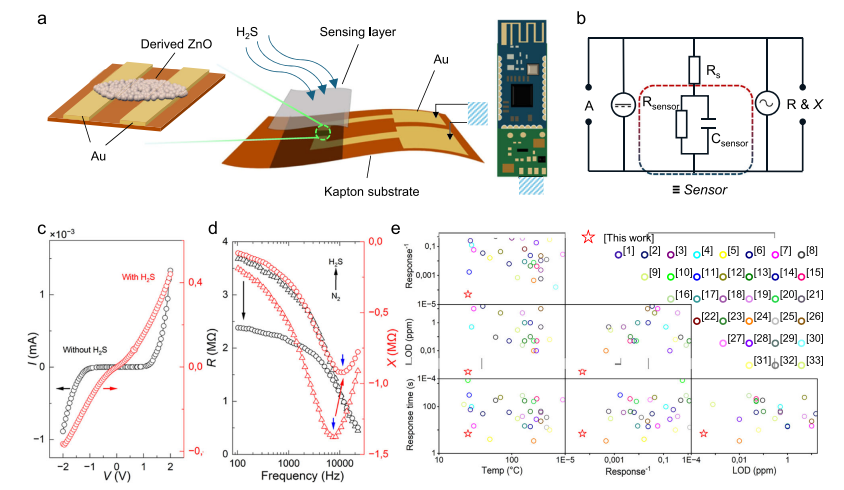

Hydrogen sulfide (H2S) is a highly toxic and corrosive gas that requires continuous, real-time monitoring at ultra-low concentrations in complex environments. Here we report a wireless, ultra-low-power H2S sensing platform for long-term, on-site detection. The device achieves a response exceeding 10,000%, a calculated detection limit of 0.328 ppb, and a 7 s response at room temperature, while consuming less than 0.7 μW. This performance represents a 4–5-fold faster response and up to 105-fold lower active sensing power than commercial H2S sensors. The Au-interfaced MOF-derived architecture synergistically modulates Schottky barriers and grain boundaries, producing a 0.4 eV Schottky barrier shift and increasing current density by more than 106-fold. We further demonstrate practical monitoring of food spoilage, pipeline leakage, and H2S accumulation in confined industrial environments, highlighting a robust strategy for next-generation smart environmental monitoring.

 A robust high-performance H2S sensor enabling real-world wireless monitoring