 On-demand linkage cleavage in two-dimensional conjugated metal-organic frameworks for closed-loop recyclable electronics
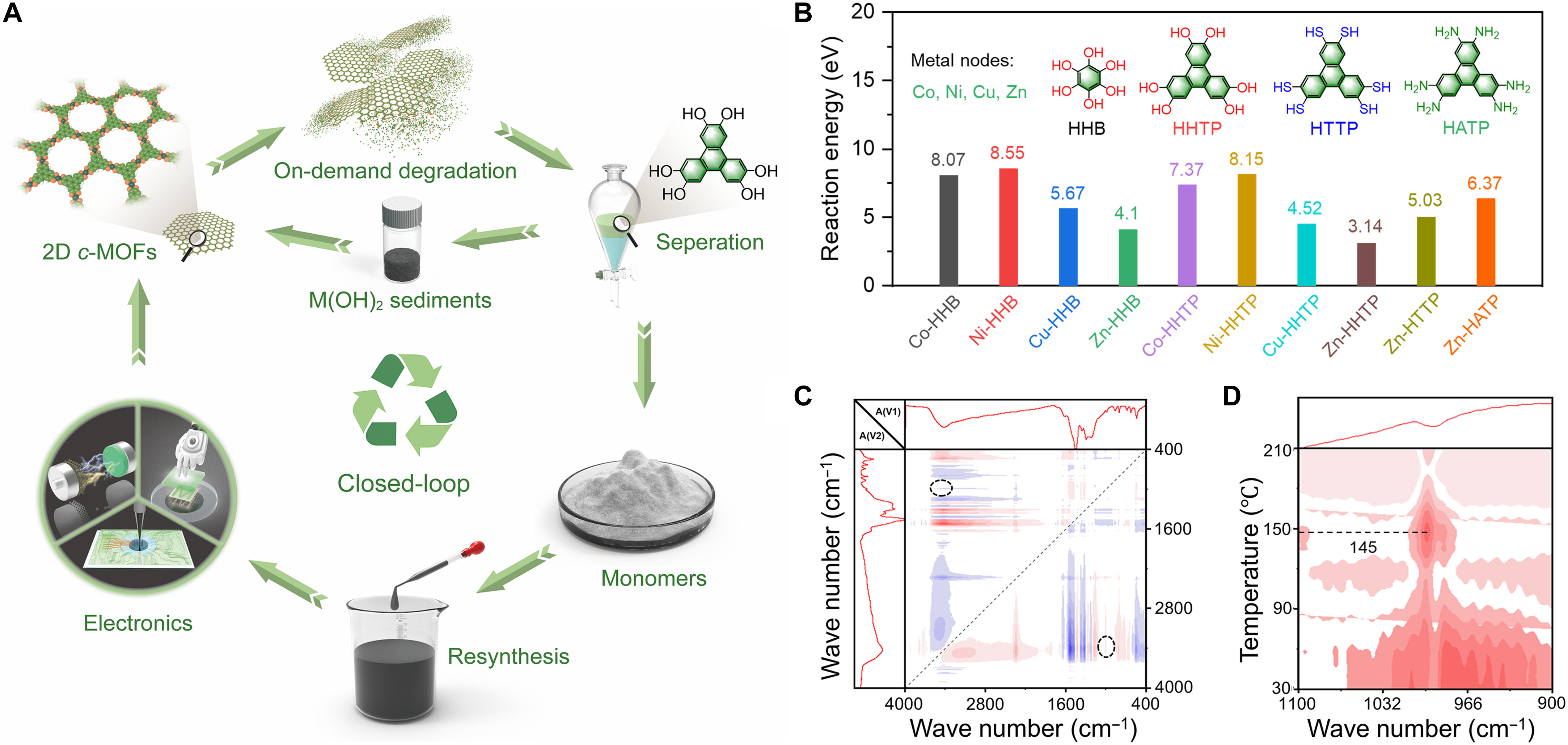
The rapid growth of modern electronics has intensified concerns about electronic waste management at the end of a product’s life. Integrating closed-loop recyclability, where electronic materials can be efficiently recovered, reprocessed, and reused in regenerated products, is essential for achieving sustainable development, minimizing environmental impact, and realizing long-term economic benefits. However, achieving closed-loop recycling remains particularly challenging for complex electronic materials. Here, we demonstrate the closed-loop recycling of emerging multifunctional two-dimensional conjugated metal-organic frameworks (2D c-MOFs) through a mechanochemistry-induced on-demand degradation strategy. Exemplified with 2,3,6,7,10,11-hexahydroxytriphenylene (HHTP)–based 2D c-MOFs, we show that ultrasonic cavitation facilitates selective cleavage of metal-ligand linkages in alkaline solutions enabling rapid material degradation (up to 92.4% within 30 min). The HHTP monomers are subsequently recovered with high purity and yield (96.3%), and reused to regenerate 2D c-MOFs, establishing a complete circular material life cycle. Our cradle-to-cradle life-cycle assessment reveals that, compared with direct synthesis, this closed-loop recycling approach substantially reduces both total energy consumption (52 versus 358 MJ kg−1) and greenhouse gas (CO2) emission (4.8 versus 27.4 kg CO2-equiv), thereby substantially lowering the overall environmental impact relative to conventional electronic materials. Moreover, we demonstrate the practical utility of these recyclable 2D c-MOFs in several applications, including hydrogen gas sensors, supercapacitor electrodes, and degradable printed electronic devices. These results highlight the potential of 2D c-MOFs to advance circular electronics, laying the groundwork for a sustainable transformation within the electronics industry.
 On-demand linkage cleavage in two-dimensional conjugated metal-organic frameworks for closed-loop recyclable electronics
The rapid growth of modern electronics has intensified concerns about electronic waste management at the end of a product’s life. Integrating closed-loop recyclability, where electronic materials can be efficiently recovered, reprocessed, and reused in regenerated products, is essential for achieving sustainable development, minimizing environmental impact, and realizing long-term economic benefits. However, achieving closed-loop recycling remains particularly challenging for complex electronic materials. Here, we demonstrate the closed-loop recycling of emerging multifunctional two-dimensional conjugated metal-organic frameworks (2D c-MOFs) through a mechanochemistry-induced on-demand degradation strategy. Exemplified with 2,3,6,7,10,11-hexahydroxytriphenylene (HHTP)–based 2D c-MOFs, we show that ultrasonic cavitation facilitates selective cleavage of metal-ligand linkages in alkaline solutions enabling rapid material degradation (up to 92.4% within 30 min). The HHTP monomers are subsequently recovered with high purity and yield (96.3%), and reused to regenerate 2D c-MOFs, establishing a complete circular material life cycle. Our cradle-to-cradle life-cycle assessment reveals that, compared with direct synthesis, this closed-loop recycling approach substantially reduces both total energy consumption (52 versus 358 MJ kg−1) and greenhouse gas (CO2) emission (4.8 versus 27.4 kg CO2-equiv), thereby substantially lowering the overall environmental impact relative to conventional electronic materials. Moreover, we demonstrate the practical utility of these recyclable 2D c-MOFs in several applications, including hydrogen gas sensors, supercapacitor electrodes, and degradable printed electronic devices. These results highlight the potential of 2D c-MOFs to advance circular electronics, laying the groundwork for a sustainable transformation within the electronics industry.