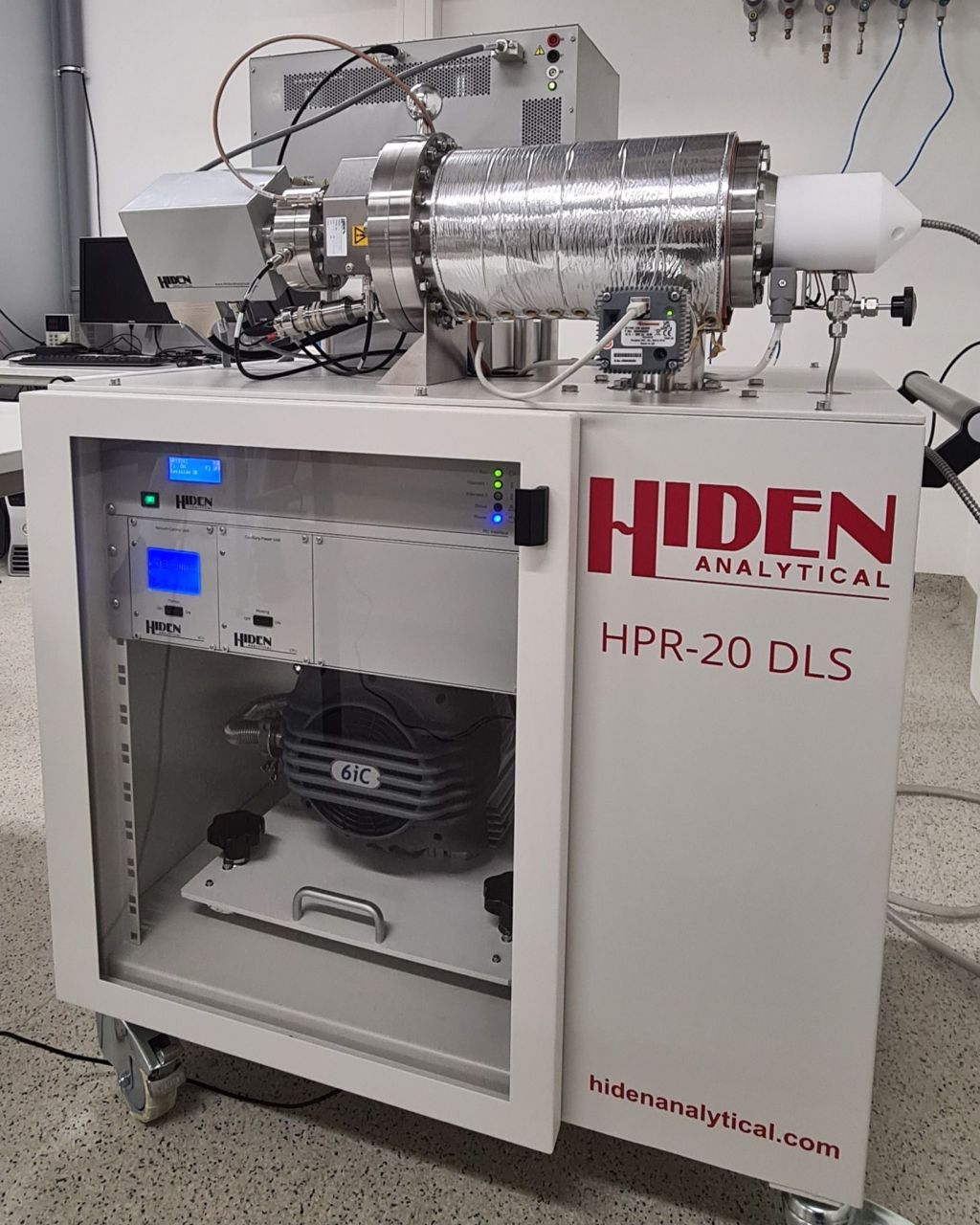
| Manufacturer: | Hiden Analytical |
| Facility: | Chair of Materials Science and Nanotechnology | Partner: | TU Dresden |
| Location: | BAR S74A |
The Hiden DLS-20 QMS is a quadrupole mass spectrometer specifically designed for the analysis of Hydrogen and Helium Isotopes and light molecules with atomi mass unit range up to 200 amu and includes a special mass filter designed for ultra high resolution. The new mass filter design is a micron precision assembly using the finest precision machined components.
The DLS 20 includes a unique, user switchable mode allowing the DLS 20 quadrupole mass spectrometer to operate in both the zone I and the zone H stability regions offering ultra-high resolution in the mass range to 20 amu in the stability zone H and very high-resolution performance up to 200 amuin the stability zone 1, providing peak full width at half maximum lower than 0.003 amu.
The ultra-high resolution of this QMS makes it possible to differentiate between moleculse with a percision down to 0.004 amu. For instance, the DLS-20 is able to discriminate between ions of D2 and He in the nuclear fusion experiments.
The DLS-20 QMS has a special Hiden QIC quartz-lined sampling interface which operates at temperatures up to 200 °C, which provides fast sampling times of less than 300 millisecond for molecules. Our QMS includes a platinum ioniser which makes the QMS capable to operate under corrosive molecules sampling.
Mass Range – nominal: The DLS-20 system can be operated in both first and second stability regions, zone I and zone H. Software selectable and switchable.
Exact Mass range /RF matching is optimised for both modes of operation, and is fixed on system test
1: 200 amu operating in first stability region, zone I;
2: 20 amu – operating in the second stability region, zone H.
Maximum Operating Pressure: 5x10⁻⁶ mbar.
Resolution:
- First Stability Region, Zone I: at mass 4: m/Δm = 667, or m/Δm = 1000 (Defined as peak width of 0.006 amu at 10% peak height or 0.004 amu FWHM).
- Second stability Region, Zone H: At mass 40: m/Δm = 600 (This represents a peak width of 0.07 amu at 10% peak height)
Detection limit of Xe isotop in Air: ≤ 5 ppb
Detector: Ion Counting Channeltron Electron Multiplier digital detector.
Minimum Detectable Partial Pressure: 3x10-18 Torr.
Detector Dynamic Range: 7 decade continuous log scale.
Measurement speed: up to 1000 measurements per second.
Ion Source: Electron bombardment type, radially symmetric low profile.
Filament: Twin filament out of platinum.
Mass filter- 20mm pole diameter : Triple stage mass filter with pre- and post-filters.
Electron emission: Software variable 1 µA to 2 mA.
Electron energy: Software variable 0 V to 150 eV.
Ion energy: Software variable 0 V to 10 eV.
Analyzer mounting flange: DN-150-CF (8"/200 mm OD Conflat-type) base flange.
Analyzer insertion length from base flange face: 348 mm from DN-150-CF base flange.
RF head dimensions: Free-standing module 438 mm x 276 mm x 274 mm with 0.9 m RF cables to the analyzer head.
| Manufacturer: | Hiden Analytical |
| Facility: | Chair of Materials Science and Nanotechnology | Partner: | TU Dresden |
| Location: | BAR S74A |
The Hiden DLS-20 QMS is a quadrupole mass spectrometer specifically designed for the analysis of Hydrogen and Helium Isotopes and light molecules with atomi mass unit range up to 200 amu and includes a special mass filter designed for ultra high resolution. The new mass filter design is a micron precision assembly using the finest precision machined components.
The DLS 20 includes a unique, user switchable mode allowing the DLS 20 quadrupole mass spectrometer to operate in both the zone I and the zone H stability regions offering ultra-high resolution in the mass range to 20 amu in the stability zone H and very high-resolution performance up to 200 amuin the stability zone 1, providing peak full width at half maximum lower than 0.003 amu.
The ultra-high resolution of this QMS makes it possible to differentiate between moleculse with a percision down to 0.004 amu. For instance, the DLS-20 is able to discriminate between ions of D2 and He in the nuclear fusion experiments.
The DLS-20 QMS has a special Hiden QIC quartz-lined sampling interface which operates at temperatures up to 200 °C, which provides fast sampling times of less than 300 millisecond for molecules. Our QMS includes a platinum ioniser which makes the QMS capable to operate under corrosive molecules sampling.
Mass Range – nominal: The DLS-20 system can be operated in both first and second stability regions, zone I and zone H. Software selectable and switchable.
Exact Mass range /RF matching is optimised for both modes of operation, and is fixed on system test
1: 200 amu operating in first stability region, zone I;
2: 20 amu – operating in the second stability region, zone H.
Maximum Operating Pressure: 5x10⁻⁶ mbar.
Resolution:
- First Stability Region, Zone I: at mass 4: m/Δm = 667, or m/Δm = 1000 (Defined as peak width of 0.006 amu at 10% peak height or 0.004 amu FWHM).
- Second stability Region, Zone H: At mass 40: m/Δm = 600 (This represents a peak width of 0.07 amu at 10% peak height)
Detection limit of Xe isotop in Air: ≤ 5 ppb
Detector: Ion Counting Channeltron Electron Multiplier digital detector.
Minimum Detectable Partial Pressure: 3x10-18 Torr.
Detector Dynamic Range: 7 decade continuous log scale.
Measurement speed: up to 1000 measurements per second.
Ion Source: Electron bombardment type, radially symmetric low profile.
Filament: Twin filament out of platinum.
Mass filter- 20mm pole diameter : Triple stage mass filter with pre- and post-filters.
Electron emission: Software variable 1 µA to 2 mA.
Electron energy: Software variable 0 V to 150 eV.
Ion energy: Software variable 0 V to 10 eV.
Analyzer mounting flange: DN-150-CF (8"/200 mm OD Conflat-type) base flange.
Analyzer insertion length from base flange face: 348 mm from DN-150-CF base flange.
RF head dimensions: Free-standing module 438 mm x 276 mm x 274 mm with 0.9 m RF cables to the analyzer head.