Installation of an Ultra-High-Resolution Quadrupole Mass Spectrometer within the FIT4H2 Project
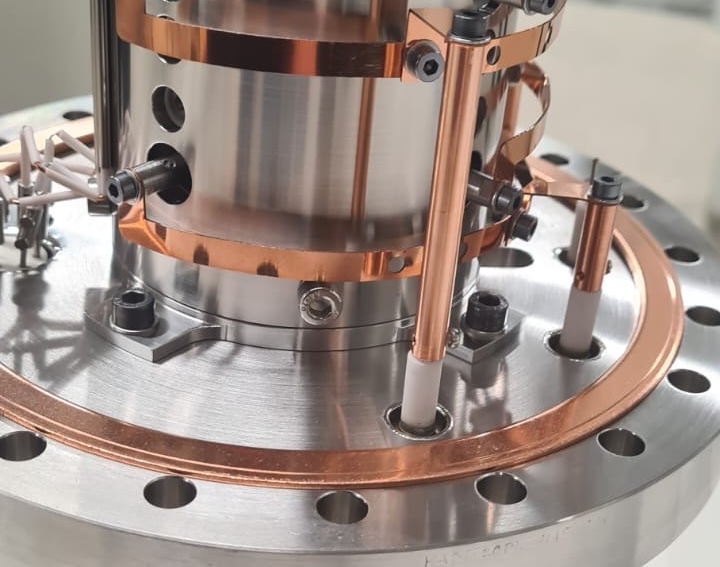
The Chair of Materials Science and Nanotechnology is pleased to announce the installation of a state-of-the-art ultra-high-resolution quadrupole mass spectrometer of the type Hiden DLS-20 QMS from Hiden Analytical as part of the BMFTR-funded FIT4H2 project.
The newly installed instrument significantly expands our analytical capabilities by enabling high-sensitivity and high-resolution mass spectrometric analysis of complex material systems. Notably, the system provides sufficient mass resolution to reliably differentiate between deuterium (D₂, 4.028 amu) and helium (He, 4.0026 amu), two species with nearly identical nominal masses, thereby allowing unambiguous discrimination. Furthermore, the UHR-QMS achieves detection limits down to 3.5 ppb, enabling trace-level analysis critical for hydrogen-related research, leakage detection, and degradation studies in advanced materials and nanostructures.
This capability is particularly relevant for ongoing research on hydrogen technologies, catalyst materials and catalysis, membranes, and nanostructured systems, where precise identification and quantification of molecules with atomic mass unit range between 1 and 200 are essential. This advanced analytical performance is directly relevant to research on hydrogen technologies, catalyst materials, membranes, and nanostructured systems within the FIT4H2 framework.
The capabilities of our new device are unique and highly valuable for research topics beyond the scope of Fit4H2, i. e. hydrogen generation, isotope research and nuclear fusion-related era, where accurate identification and precise quantification of hydrogen isotopes and helium are crucial for understanding plasma-material interactions, fuel retention, permeation, and degradation phenomena in advanced materials.
We gratefully acknowledge the support of the funding agencies BMFTR, Projektträger Jülich, FIONA, and the Italian funding agencies MUR; MAECI, whose contributions made the acquisition and installation of this advanced analytical technology possible.
The installation of this instrument represents an important ignition spark and milestone in strengthening the experimental infrastructure of the FIT4H2 project and will support high-impact research, interdisciplinary collaboration, and advanced training of researchers and students.

 Hydrogen Gas Sensing Performance of Iron Oxide-Decorated Carbon Nanotubes: The Influence of Iron Oxide Species and Concentration
Installation of an Ultra-High-Resolution Quadrupole Mass Spectrometer within the FIT4H2 Project
The Chair of Materials Science and Nanotechnology is pleased to announce the installation of a state-of-the-art ultra-high-resolution quadrupole mass spectrometer of the type Hiden DLS-20 QMS from Hiden Analytical as part of the BMFTR-funded FIT4H2 project.
The newly installed instrument significantly expands our analytical capabilities by enabling high-sensitivity and high-resolution mass spectrometric analysis of complex material systems. Notably, the system provides sufficient mass resolution to reliably differentiate between deuterium (D₂, 4.028 amu) and helium (He, 4.0026 amu), two species with nearly identical nominal masses, thereby allowing unambiguous discrimination. Furthermore, the UHR-QMS achieves detection limits down to 3.5 ppb, enabling trace-level analysis critical for hydrogen-related research, leakage detection, and degradation studies in advanced materials and nanostructures.
This capability is particularly relevant for ongoing research on hydrogen technologies, catalyst materials and catalysis, membranes, and nanostructured systems, where precise identification and quantification of molecules with atomic mass unit range between 1 and 200 are essential. This advanced analytical performance is directly relevant to research on hydrogen technologies, catalyst materials, membranes, and nanostructured systems within the FIT4H2 framework.
The capabilities of our new device are unique and highly valuable for research topics beyond the scope of Fit4H2, i. e. hydrogen generation, isotope research and nuclear fusion-related era, where accurate identification and precise quantification of hydrogen isotopes and helium are crucial for understanding plasma-material interactions, fuel retention, permeation, and degradation phenomena in advanced materials.
We gratefully acknowledge the support of the funding agencies BMFTR, Projektträger Jülich, FIONA, and the Italian funding agencies MUR; MAECI, whose contributions made the acquisition and installation of this advanced analytical technology possible.
The installation of this instrument represents an important ignition spark and milestone in strengthening the experimental infrastructure of the FIT4H2 project and will support high-impact research, interdisciplinary collaboration, and advanced training of researchers and students.
Hydrogen Gas Sensing Performance of Iron Oxide-Decorated Carbon Nanotubes: The Influence of Iron Oxide Species and Concentration