Computational design of sensing materials remains fundamentally challenging due to the vast configurational landscape and the absence of robust property correlations that enable efficient molecular representation. These challenges become particularly critical in healthcare applications, where reliable and interpretable molecular recognition is essential for non-invasive diagnostics. To address these challenges, we developed MORE-ML, a quantum-informed AI framework that combines electronic-structure-derived properties of e-nose molecular building blocks with machine learning (ML) methods to uncover sensing mechanisms and guide the design of new systems. Within this framework, we expanded our previous dataset, MORE-Q, to MORE-QX by sampling a larger conformational space of interactions between body odor volatilomes (BOV) molecules and mucin-derived receptors, both in the gas phase and when deposited on graphene. MORE-QX provides extensive electronic binding features (BFs) computed upon BOV adsorption. Analysis of the property space revealed weak correlations between quantum-mechanical (QM) properties of building blocks and resulting BFs. Leveraging this observation, we defined electronic descriptors of building blocks as inputs for tree-based ML models to predict BFs. Benchmarking showed CatBoost models outperform alternatives, especially in transferability to unseen compounds. Through explainable AI, we reduced the high-dimensional QM property space to a compact and physically interpretable set of descriptors, revealing the properties that most influence BF predictions. Collectively, MORE-ML combines QM insights with ML to provide mechanistic understanding and rational design principles for artificial sensing materials in BOV sensing. This approach establishes a foundation for advancing materials capable of analyzing complex odor mixtures, bridging the gap between molecular-level computations and practical e-nose applications.
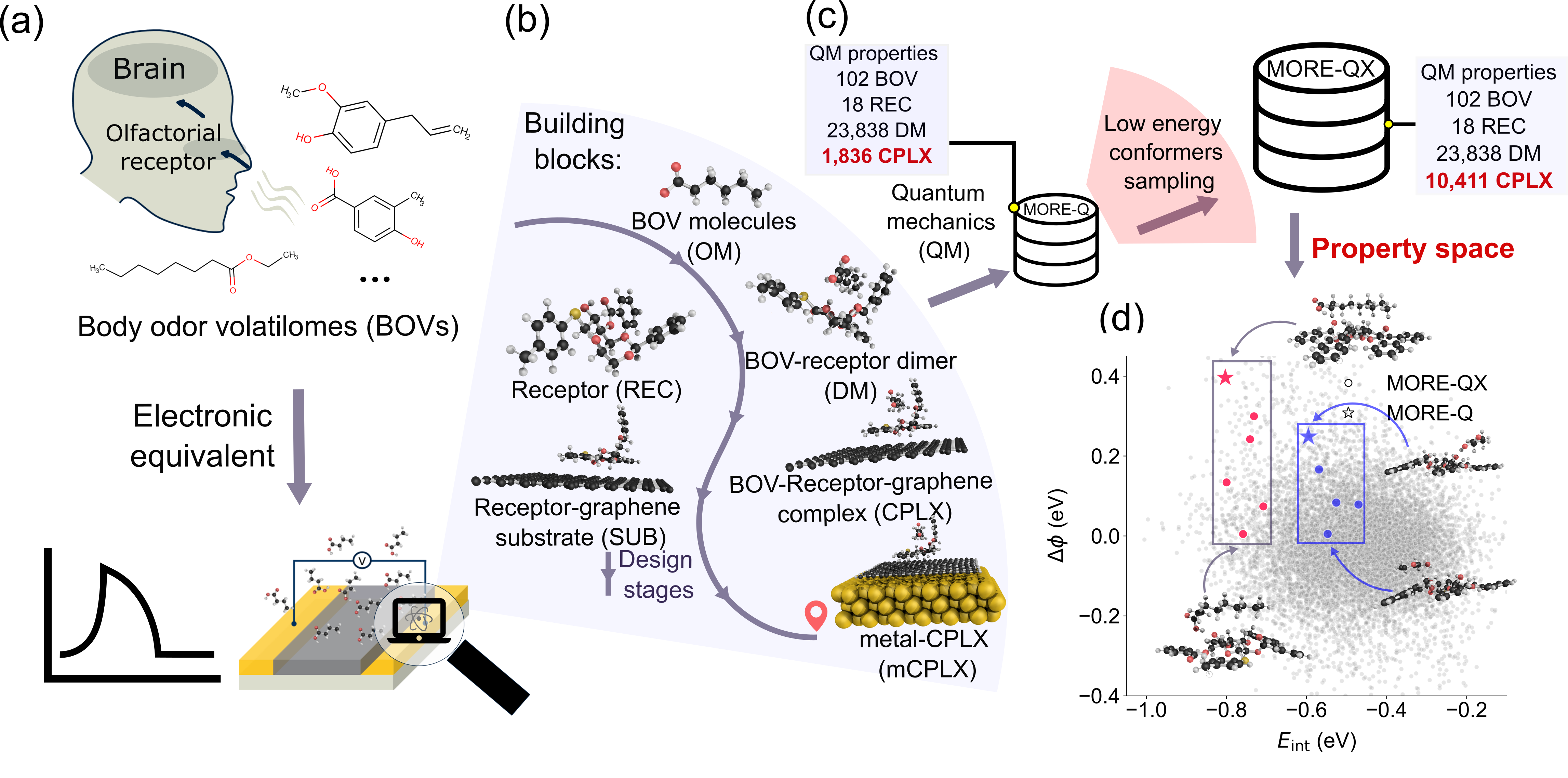

Computational design of sensing materials remains fundamentally challenging due to the vast configurational landscape and the absence of robust property correlations that enable efficient molecular representation. These challenges become particularly critical in healthcare applications, where reliable and interpretable molecular recognition is essential for non-invasive diagnostics. To address these challenges, we developed MORE-ML, a quantum-informed AI framework that combines electronic-structure-derived properties of e-nose molecular building blocks with machine learning (ML) methods to uncover sensing mechanisms and guide the design of new systems. Within this framework, we expanded our previous dataset, MORE-Q, to MORE-QX by sampling a larger conformational space of interactions between body odor volatilomes (BOV) molecules and mucin-derived receptors, both in the gas phase and when deposited on graphene. MORE-QX provides extensive electronic binding features (BFs) computed upon BOV adsorption. Analysis of the property space revealed weak correlations between quantum-mechanical (QM) properties of building blocks and resulting BFs. Leveraging this observation, we defined electronic descriptors of building blocks as inputs for tree-based ML models to predict BFs. Benchmarking showed CatBoost models outperform alternatives, especially in transferability to unseen compounds. Through explainable AI, we reduced the high-dimensional QM property space to a compact and physically interpretable set of descriptors, revealing the properties that most influence BF predictions. Collectively, MORE-ML combines QM insights with ML to provide mechanistic understanding and rational design principles for artificial sensing materials in BOV sensing. This approach establishes a foundation for advancing materials capable of analyzing complex odor mixtures, bridging the gap between molecular-level computations and practical e-nose applications.

 Towards the design of artificial sensing materials via quantum-informed explainable AI