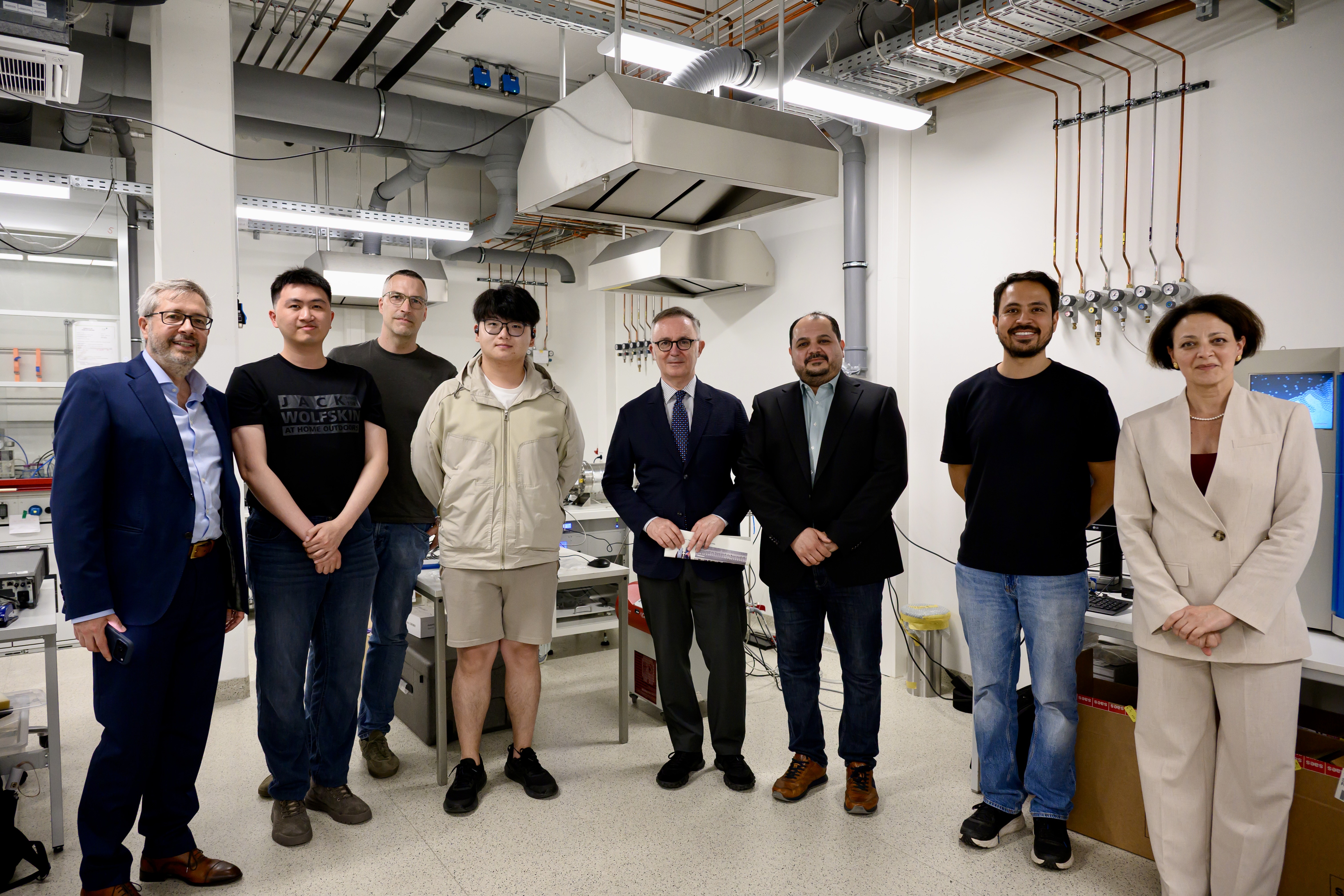
On June 9, 2026, H.E. Fabrizio Bucci, Ambassador of the Italian Republic to Germany, visited TU Dresden as part of a program dedicated to strengthening Italian-German cooperation in science, innovation, and technological development. The visit highlighted the central role of international scientific collaboration in addressing strategic challenges in technology, energy, and industrial transformation. The Ambassador was welcomed by representatives of the university leadership before visiting the laboratories of the Cuniberti Group at the Dresden Center for Nanoanalysis (DCN). During the visit, he was introduced to ongoing research activities in nanoelectronics, advanced sensing technologies, and energy-related applications. Particular attention was devoted to the Fit4H2 project, a German-Italian collaborative initiative involving TU Dresden, Saxon industrial partners, the Istituto Italiano di Tecnologia (IIT) in Genoa, and Italian companies. The project develops next-generation nanoelectronic sensors for hydrogen technologies and serves as an example of how academic excellence, industrial innovation, and European technology policy can be successfully integrated. A key highlight of the visit was the meeting with the Italian scientific community at TU Dresden. Organized by SIGN e.V., the Network of Italian Scientists and Scholars in Germany, the event brought together professors, researchers, doctoral candidates, and students from a wide range of disciplines. Through a series of concise science presentations, participants showcased current research activities and emerging scientific developments, providing a snapshot of the vitality and diversity of the Italian research community in Dresden. The visit underscored the growing importance of scientific diplomacy and international talent for the competitiveness of European research institutions. It also reflected the broader strategic partnership between Germany and Italy in areas such as research, innovation, digitalization, energy, and technological sovereignty. The program concluded with an informal reception on campus, offering additional opportunities for dialogue between representatives of academia, diplomacy, and industry.
On June 9, 2026, H.E. Fabrizio Bucci, Ambassador of the Italian Republic to Germany, visited TU Dresden as part of a program dedicated to strengthening Italian-German cooperation in science, innovation, and technological development. The visit highlighted the central role of international scientific collaboration in addressing strategic challenges in technology, energy, and industrial transformation. The Ambassador was welcomed by representatives of the university leadership before visiting the laboratories of the Cuniberti Group at the Dresden Center for Nanoanalysis (DCN). During the visit, he was introduced to ongoing research activities in nanoelectronics, advanced sensing technologies, and energy-related applications. Particular attention was devoted to the Fit4H2 project, a German-Italian collaborative initiative involving TU Dresden, Saxon industrial partners, the Istituto Italiano di Tecnologia (IIT) in Genoa, and Italian companies. The project develops next-generation nanoelectronic sensors for hydrogen technologies and serves as an example of how academic excellence, industrial innovation, and European technology policy can be successfully integrated. A key highlight of the visit was the meeting with the Italian scientific community at TU Dresden. Organized by SIGN e.V., the Network of Italian Scientists and Scholars in Germany, the event brought together professors, researchers, doctoral candidates, and students from a wide range of disciplines. Through a series of concise science presentations, participants showcased current research activities and emerging scientific developments, providing a snapshot of the vitality and diversity of the Italian research community in Dresden. The visit underscored the growing importance of scientific diplomacy and international talent for the competitiveness of European research institutions. It also reflected the broader strategic partnership between Germany and Italy in areas such as research, innovation, digitalization, energy, and technological sovereignty. The program concluded with an informal reception on campus, offering additional opportunities for dialogue between representatives of academia, diplomacy, and industry.